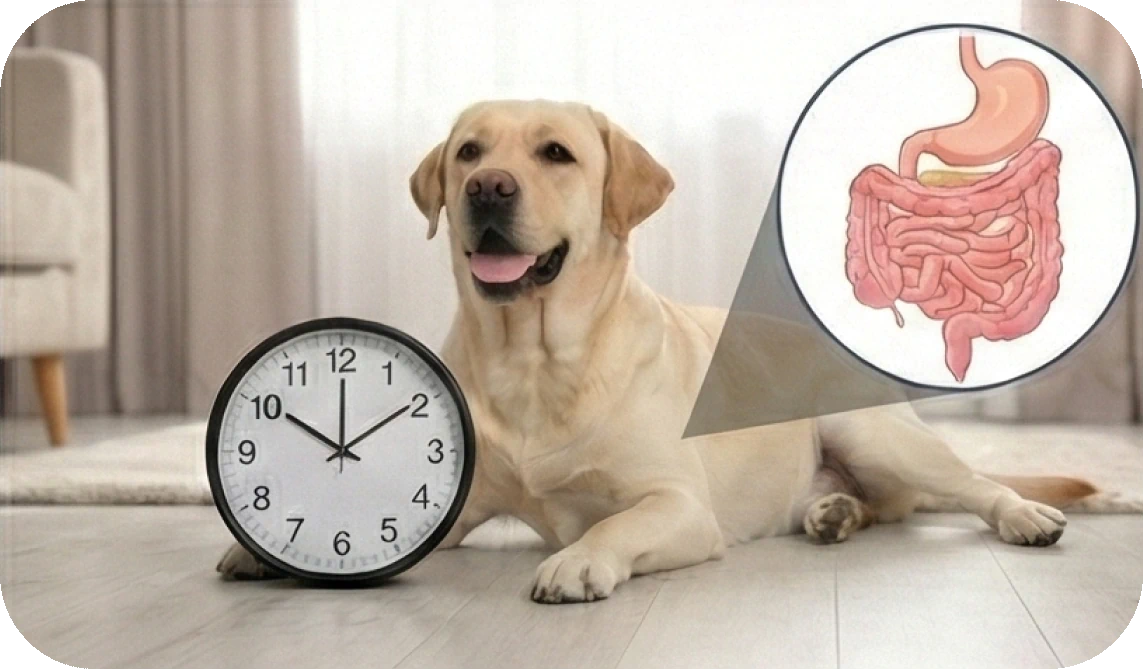
How Long Does It Take a Dog to Digest Food?
Similar to humans, dogs need to digest their food to absorb nutrients, but the amount of time required for digestion to take place is not the same as it is in people. Cats, horses, ferrets, and canines all break down food at marginally diverse rates owing to their anatomy, body size, health conditions they may have, and other considerations.
What is Digestion?
Digestion refers to the process where food is broken down so the body can absorb it. Vitamins, minerals, fats, sugars, and other crucial nutrients and components are contained in the food canines eat. Without digestion, this food is incapable of being assimilated into their bodies. The digestive process is consequently vital because if a dog is unable to utilize these nutrients, fundamental cellular and life-sustaining functions cannot happen within their body.
How is Food Digested by Dogs?
The digestive system encompasses more than just a dog's stomach. It begins with the mouth, where a dog chews the food it consumes. From there, the food travels through the esophagus to the stomach using a process called peristalsis, while the epiglottis prevents it from entering the trachea.
Within the stomach, digestive juices further break down the food. A sphincter between the esophagus and the stomach ensures that the digested food remains in the stomach and doesn't come back up the esophagus. Once the food is sufficiently broken down in the stomach, it moves into the small intestines.
The small intestines consist of three parts: the duodenum, jejunum, and ileum. As the food passes through these interconnected sections of the small intestines, it mixes with additional juices from the pancreas, the liver via the gallbladder, and the intestines. During this process, water and nutrients are absorbed. Waste products continue to travel through the small intestines and into the large intestines, which comprise the cecum, colon, rectum, and anal canal.
Lastly, the cecum connects the ileum to the colon, where stool is stored until it is eventually expelled from the body through the rectum and anal canal.
How Long Does the Digestive Process Take in a Dog?
The complete digestion process, starting from the mouth and ending at the anal canal, has traditionally been estimated to take around 6 to 8 hours in dogs. However, certain studies propose that it may take up to 13 hours.1
It is believed that the digestive process in giant breed dogs could take significantly longer compared to smaller dogs, potentially ranging from 21.5 to over 57 hours.
These variations indicate that the duration of this process can vary significantly depending on factors such as the size and breed of the dog, health conditions, stress levels, type of food consumed, and other influencing factors.
It is important not to confuse the overall digestion process with the time it takes for food to pass out of the stomach. Many people often associate digestion with the time it takes for a dog's stomach to become empty, but this is not the same.
A dog's stomach can empty in as little as 1.5 hours, although some studies suggest that it is more likely to take between 4 and 10 hours, or closer to the commonly stated 6 to 8-hour digestion time for dogs. Again, this timeframe will vary depending on several factors, primarily the amount and consistency of the food consumed.
Digestive Problems in Dogs
Certain dogs may have variations in their digestion speed, efficiency, or digestion problems due to issues affecting their digestive system. Examples of such problems include:
Foreign bodies
Intussusception
Tumors in the digestive system
Exocrine pancreatic insufficiency (EPI)
Intestinal parasites
Viral or bacterial infections in the digestive system
Dysbiosis
Inflammatory bowel disease (IBD)
Megacolon
Megaesophagus
Gastric dilatation volvulus (GDV)
Gastroenteritis
Trauma to the digestive system
Liver disease
Gallbladder disease
These issues, along with others, can lead to a deficiency of digestive juices and enzymes required for food breakdown, altered peristalsis motility resulting in inadequate nutrient absorption or constipation, regurgitation of food, blockages obstructing the passage of food through the digestive system, and various other complications.