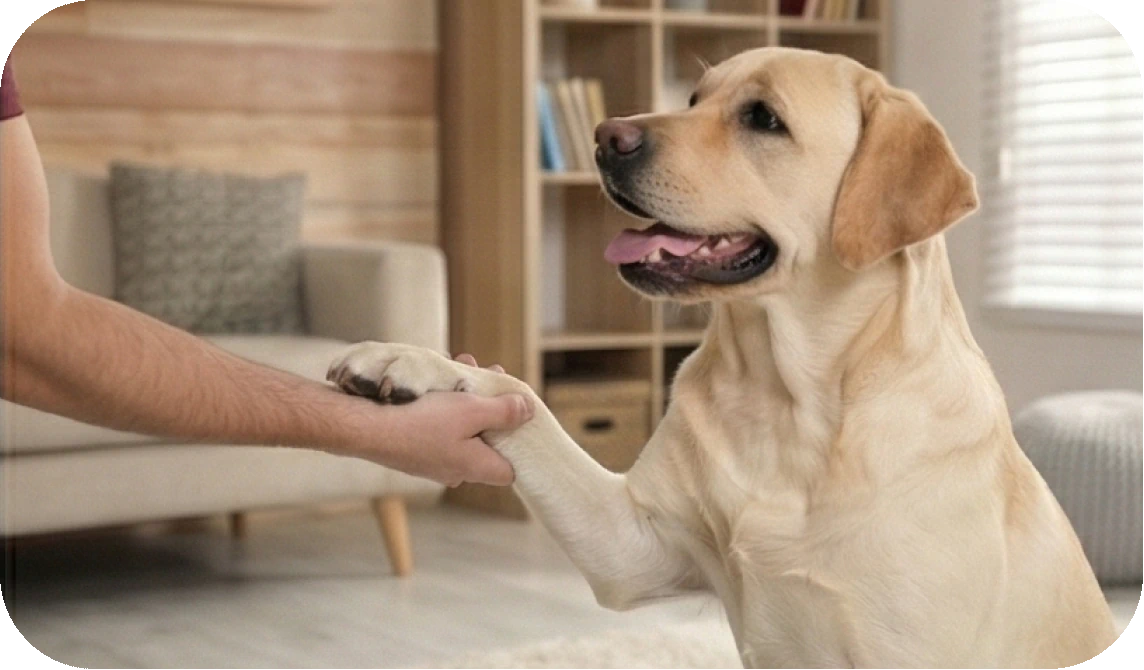
Teaching Your Dog to Shake Paws
Is your dog able to shake paws on command? Shaking paws is an enjoyable dog trick that can be taught quite easily, and most dogs can learn it rapidly. With just a few brief training sessions, your dog will start offering its paw for a shake whenever they encounter someone new.
Prepare for Training
To train a dog to shake paws, you only need two things: your dog and a handful of treats. If you are using clicker training, you will also need your clicker.
This trick requires the dog to sit calmly and give you its full attention. If it is not yet proficient in sitting reliably, it is recommended to go back and practice that command before proceeding.
Introduce "Shake"
Ask your dog to sit down. Take a treat in one hand and show it to your dog. Close your hand tightly around the treat to prevent the dog from reaching it.
Command your dog to "shake" and move your closed fist under its nose to keep its attention on the treat. Wait for your dog to start trying to get the treat from your hand. Typically, dogs will sniff around, and if that doesn't work, they will start pawing at your hand.
The moment your dog touches your hand with its paw, say "good" or use a clicker to signal approval. Open your hand and allow the dog to take the treat.
Practice
Engage in the activity of "shake" with your dog for five minutes, two or three times a day. Before you realize it, your dog will willingly extend its paw to you as soon as you give the command.
Phase out the Treat
After your dog learns to give its paw on command, you can gradually eliminate the need to hold the treat in your closed hand.
Begin by closing your hand over the treat and commanding your dog to "shake." Once it offers its paw, give it a treat from your other hand instead of the one closed in your fist. Repeat this process multiple times.
Switch Treat Hands
First, extend your hand without holding the treat and say the command "shake." Immediately reward your dog with a treat from your other hand when it offers its paw. Repeat this step during multiple training sessions. If your dog appears confused at any moment, go back one or two steps in your training.
Remove the Treat
Now you're prepared to gradually reduce the reliance on treats. Start by offering treats less frequently, initially rewarding your dog after every other time it obeys the "shake" command. Gradually decrease the frequency of treat rewards. Eventually, your dog will consistently offer its paw on command, and you will only need to occasionally provide a treat to reinforce the behavior.
Problems and Proofing Behavior
One common issue is when the dog refuses to place its paw on your hand, regardless of how long you attempt to entice it with a treat. In this case, bring the hand holding the treat closer to your dog's paw. You can even give the leg or paw a gentle nudge. Once the dog lifts its paw towards your hand, reward it with the treat and say "good" or use a clicker.
If your dog still doesn't grasp what is expected after you nudge the paw, you can try lifting the paw into your hand yourself. Give the command "shake," bend down, pick up the paw, and then praise the dog by saying "good" or using a clicker followed by a treat. Repeat this sequence quickly several times in a row, treating the dog each time, and then return to the initial step mentioned above. Most dogs will now understand the expectation and start offering their paw.
Remember to be patient and keep the training sessions short. If your dog becomes frustrated or bored, it's time to conclude the session. Always try to end on a positive note, even if it means asking your dog to perform a simple command, such as sit.
Once your dog consistently shakes paws with you, it's time to reinforce the behavior. The best way to do this is to have another person ask your dog to shake. The more familiar your dog is with the person, the easier it will be. First, demonstrate the approach with your dog, so the person can imitate you as closely as possible. Then, have that person sit the dog down and request a shake. Repeat this exercise with a few different people, and your dog will learn that people enjoy shaking paws! After your dog has mastered shaking, you can proceed to teach it how to wave.